
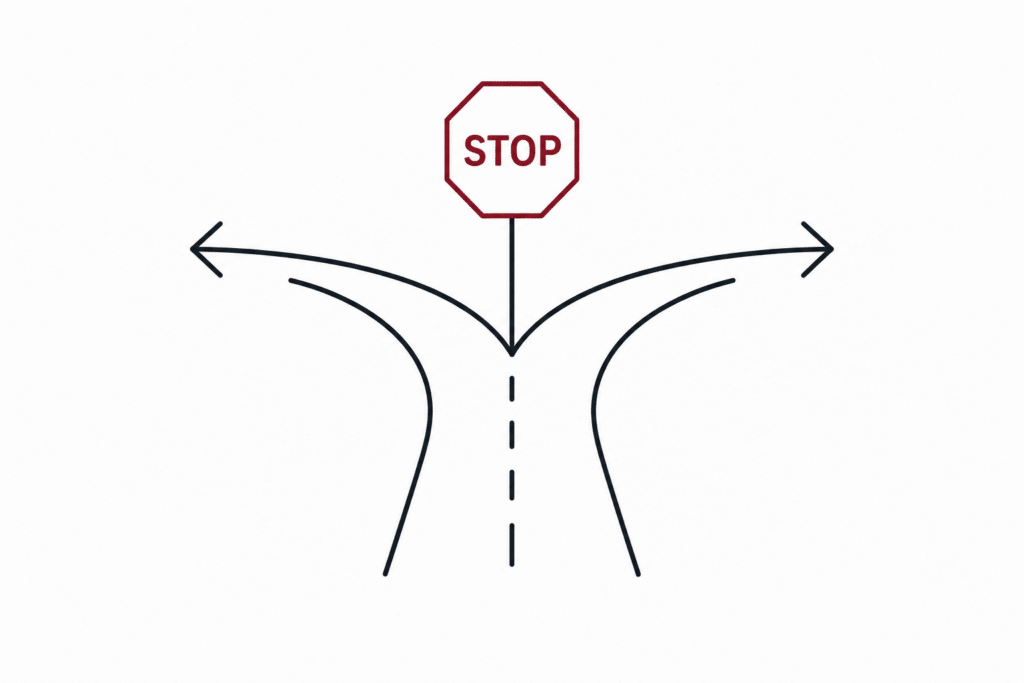
Why the problem in most companies is rarely the strategy itself, but much more often the way leadership teams work around strategy.
Strategy is one of the most frequently discussed topics in management. Companies organize strategic workshops, prepare market analyses and create ambitious development plans. Yet in many organizations, little changes after a few months. The strategy exists in a presentation but does not truly influence how the company operates.
Why does this happen?
Strategy is rarely the main problem
Contrary to popular belief, the problem very rarely lies in the strategy itself. In many companies, the strategy is good enough. The leadership team understands the market, knows the organization’s strengths and has a general idea of the company’s future direction.
The difficulties arise later — at the moment when the strategy should start working in practice. That is precisely when many organizations begin returning to day-to-day operations.
The return to operations
Leadership teams operate under significant operational pressure. Urgent client matters arise, team tensions appear, production issues emerge or new sales projects demand attention. Naturally, leadership teams begin to focus on current affairs.
As a result, leadership meetings increasingly focus on operational topics, while less and less time is spent discussing the company’s future direction. Strategy gradually takes a back seat — not because it is unimportant, but because there is no system for working around strategy.
Too many initiatives
The second common problem is an excess of initiatives. After strategic workshops, a long list of projects emerges, each of which seems important and justified.
The problem is that organizations try to do too many things at once. The company’s resources become scattered across numerous projects, and none of them receives sufficient attention from the leadership team. As a result, instead of focusing the company’s energy, strategy begins to disperse it.
Avoiding difficult decisions
Strategy always means making choices, and choices also mean giving up certain activities. In practice, many leadership teams try to avoid these moments.
Instead of clear decisions, compromises appear. Organizations try to do everything at once, which further disperses the company’s energy and resources.
The lack of a strategy and execution system
Most often, however, the problem has an even deeper source. In many companies, the leadership team does not have a system for working around strategy and execution.
Strategy is discussed once a year during a strategic workshop. Later, it appears in quarterly presentations but does not become part of the leadership team’s regular way of working. In this situation, even a good strategy quickly loses its power.
Management Operating System™
That is why, in my work with business owners, CEOs and leadership teams, I focus not only on strategy itself but, above all, on how they work together to make and execute strategic decisions.
Over time, I named this way of working the Management Operating System™. It is a system for how leadership teams work around strategy and execution.
It includes, among other things, clearly defining the company’s strategic direction, selecting a few key priorities, establishing a regular leadership operating rhythm around strategy and creating a system for monitoring execution.
Strategy starts working
When leadership teams begin to work this way, something important happens. Strategy stops being a separate project and becomes a natural part of how the company is run.
The most important topics regularly return to the leadership team’s agenda, priorities become clear across the organization and strategic decisions are made faster.
Strategy and execution begin to work together — and that is when real results appear.